Saturday 2 May 2026 · articles
Hollywood Groove: Live Movie Music with Real-Time Trivia for Wedding Guests
By Michael Smedley
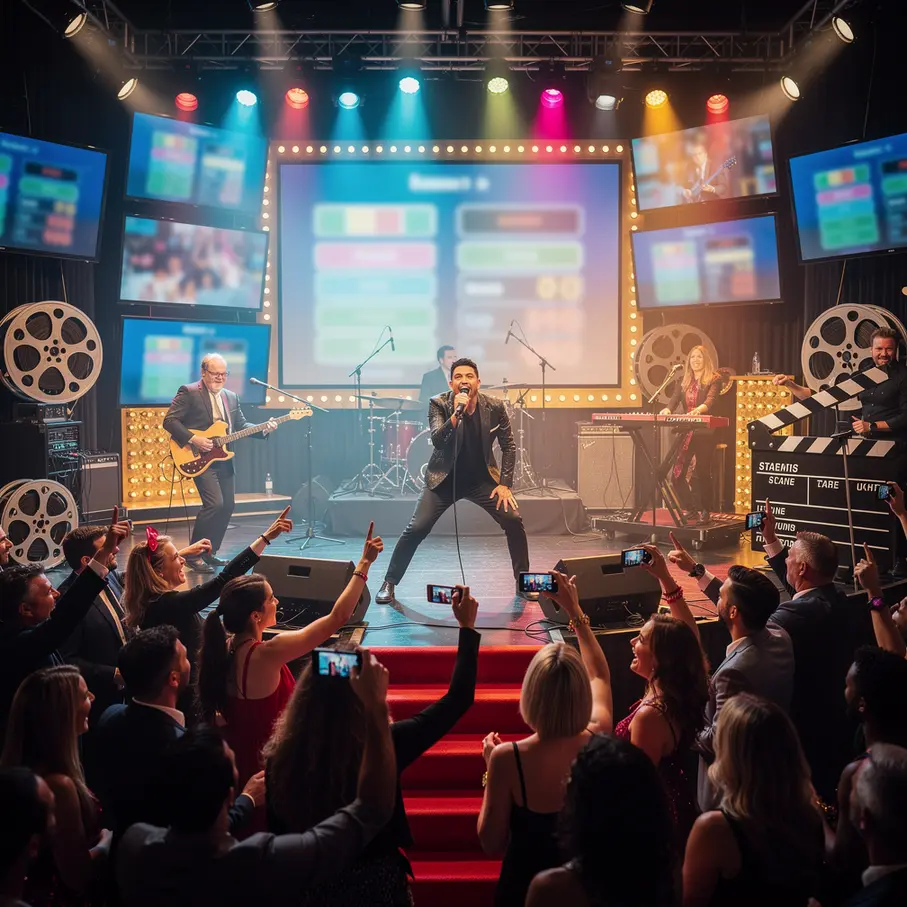
Wedding guests have changed. A five-hour playlist and a few speeches no longer cut it for couples who want their reception to feel like an event, not a waiting room for the dance floor. Hollywood Groove gives you a live band playing iconic movie hits combined with real-time trivia that every guest plays on their phone—turning your reception into a proper show where your mates and relatives actually compete, laugh and stay locked in from entrée to last dance.
Why “Just a Band” Leaves Gaps in Your Reception Timeline
Most Melbourne wedding couples book entertainment based on two questions: “Do you know our first dance song?” and “Can you play ‘September’?” The problem isn’t the setlist—it’s the dead air. You’ve got three hours between the last speech and the venue’s curfew. Traditional bands fill it with song after song, but here’s what actually happens: your uni friends dominate the dance floor while your partner’s aunts sit with empty wine glasses, your parents’ mates check their phones, and the energy splutters between peak tracks.
The industry has noticed. Over the past decade, Melbourne entertainment companies have shifted toward hybrid models to plug these gaps. DJ Band Melbourne and Melbourne Interactive Entertainment now sell packages that bolt live saxophone or percussion onto a DJ set, offering a “complete experience from planning to event” across Victoria—from Albury to Delegate. The Play Agency takes a different angle, pitching stilt walkers, fire breathers and hula hoopists for weddings that need visual punch. These options work, but they solve surface problems: they add noise or movement without giving every guest a clear reason to stay mentally present.
The real issue is participation. At a 100-guest wedding, maybe 30 people will dance. The other 70 want something to do that doesn’t involve awkward shuffling or forced small talk with your dad’s work colleagues. That’s where interactive entertainment earns its spot—not as a gimmick, but as a structural fix for the modern reception.
What “Interactive” Actually Means on the Melbourne Wedding Circuit
When couples ask for interactive entertainment, they’re usually chasing one of three outcomes: physical engagement, musical variety or mental involvement. Melbourne suppliers have focused on the first two because they’re easier to package.
Physical engagement means performers who move through the crowd. The Play Agency’s roster includes hula hoopists who teach guests tricks and stilt walkers who pose for photos. These acts create Instagram moments and work brilliantly for outdoor ceremonies or cocktail hour. For the reception itself, they’re harder to slot in—fire breathers need ceiling clearance, and roving performers can interrupt conversation.
Musical variety is the DJ-live hybrid model. Companies like DJ Band Melbourne offer a “Suave DJ Band” package: a DJ spinning tracks with live saxophone and vocals. Melbourne Interactive Entertainment runs a similar setup with percussionists adding live energy to pre-mixed sets. This keeps the sound fresh and suits couples who want club energy without losing the warmth of live music. The catch? It’s still passive. Guests listen and dance, but they don’t do anything.
Mental involvement is the gap. Trivia fills it by giving every table a shared task that runs parallel to the music. Hollywood Groove’s model—live movie hits plus synced phone trivia—means your guests aren’t just hearing “You’re the One That I Want” from Grease; they’re racing to answer which year it hit number one, watching scores update on screen and giving the winning table a bottle of champagne. It’s not a quiz night tacked onto a wedding. It’s a single entertainment act that performs and facilitates.
The DJ-Live Hybrid: What You Get and What You Don’t
Let’s be specific about the hybrid model because it’s become the default upgrade for Melbourne couples. DJ Band Melbourne’s packages typically include a DJ, MC service and one or two live musicians—saxophone, percussion or a vocalist. They’ll travel from Geelong to Gippsland, play your ceremony, canapés and reception, and include lighting in the quote. Melbourne Interactive Entertainment offers a “Sonic Drive DJ Band” with similar specs, promising to “keep your guests engaged with an interactive show.”
The engagement here is musical. A saxophonist might walk through the crowd during a solo. A percussionist could hand a tambourine to a guest. It’s interactive in the same way a good DJ reading the room is interactive—it responds, but the crowd’s job is still to dance or watch.
For many weddings, that’s enough. If you’ve got a crowd of 120 twenty-somethings at a warehouse in Brunswick, a DJ-sax combo will absolutely bang. But if your guest list mixes uni mates, relatives from Bendigo and a few work colleagues who’ve never met, the dance floor splits. The hybrids don’t give the non-dancers a parallel activity. They’re still waiting for a song they recognise, checking the time, or heading to the bar for the fourth time.
The Physical Performer Model: When to Use It, When to Skip It
The Play Agency’s approach is about spectacle. Their site lists hula hoopists, fire breathers, harpists and stilt walkers for weddings across Melbourne and Victoria. These performers solve a different problem: visual boredom. A hula hoopist teaching guests moves during cocktail hour gets people laughing and loosens up the group. A harpist during the ceremony adds elegance. Fire breathers after dessert create a wow moment.
But the reception is long. Roving performers can’t sustain three hours of engagement. They work in bursts—20 minutes of stilt walking, a 15-minute fire show—then they’re done. You’ll need to book them plus your band or DJ, which means two supplier relationships, two setups and two invoices. More importantly, physical acts don’t cross generations the way a question about Top Gun does. Your 25-year-old cousin and your 65-year-old uncle both know “Danger Zone.” Only one of them wants to learn hula hooping after three glasses of pinot.
The Missing Layer: Mental Engagement That Scales Across Guest Types
Here’s what fifteen years of playing weddings across Victoria has taught us: the best receptions give every guest a role. Not a forced role—no one wants to be dragged up for a conga line—but a voluntary, low-effort way to stay in the game.
Trivia does this because it respects different personalities. Your extroverted mate can shout answers and run to the host with his phone. Your shy aunt can tap quietly at her table and still feel the buzz when her group climbs the leaderboard. Tables of strangers become teams within minutes. The competition is light—no one’s reputation depends on knowing the Dirty Dancing soundtrack—but the dopamine hit is real. When a table wins a round, they celebrate. When they slip from first to third, they strategise. That’s three hours of sustained attention you can’t buy with a saxophone solo.
Hollywood Groove’s format is simple: guests scan a QR code on arrival, join your wedding’s private game, and answer questions between songs. Scores display on a screen near the band. Rounds run 8-10 minutes, then we’re back to a full-tilt live set. The music never becomes background—it’s the engine driving the trivia. When we play “Footloose,” the next question is about Kevin Bacon’s dance double. When we drop “Shallow” from A Star Is Born, we ask about the film’s Oscar count. The connection keeps both elements feeling essential, not stitched together.
How Hollywood Groove Actually Runs at a Melbourne Wedding
Let’s map a typical reception at a venue like a Yarra Valley winery or a converted warehouse in Preston—both setups we’ve done multiple times.
6:30pm: Guests arrive, grab a drink. We’ve placed small table cards with a QR code and a one-sentence instruction: “Scan to play movie trivia tonight.” No app download—just a web browser. Our host does a 30-second welcome: “We’re Hollywood Groove. Between songs, trivia questions will appear on your phone. Play solo or as a table. Winners get prizes.”
7:00pm: Bridal party enters, first dance. We play their song live, no trivia.
7:15pm: Entrées served. We launch into Grease megamix. Mid-set, the host pauses: “Quick question—what year did Grease hit Australian cinemas?” Guests tap 1978, 1979 or 1980 on their phones. The screen shows live results: Table 12 leads with 92% correct. A cheer goes up.
7:45pm: Main course. We shift to power ballads—Top Gun, Armageddon, Titanic. Three trivia rounds run between songs. Each round takes 90 seconds. Guests can answer while eating. The leaderboard shuffles.
8:30pm: Speeches. We mute the game but keep the screen displaying the current standings—gives people something to glance at during the father-of-the-bride’s third anecdote.
9:00pm: Dancing starts. We fire up Moulin Rouge, The Greatest Showman, Guardians of the Galaxy soundtrack hits. Trivia runs between every second song. By now, tables have developed rivalries. The dance floor stays full because the trivia players are the same people—the game gives them a reason to return after a breather.
10:30pm: Final round. We announce winners, hand over a bottle of champagne and a custom trophy if the couple wants one. The last hour is pure dance floor—trivia done, energy peaked.
The whole night runs on one PA system, one screen (usually the venue’s existing TV or projector) and our phones-as-controllers setup. No extra AV hire, no complicated briefing for the venue staff.
Timing and Flow: Where Trivia Sits in Your Runsheet
Couples stress about timing more than any other detail. You’ve paid for six hours of venue hire and you need to fill them without dead spots or chaos.
Trivia slots into the natural dips. The entrée gap—when kitchen staff plate up—is perfect for a quick round. The post-speech lull, when guests are stretching their legs, suits a two-minute question set. The hour before last drinks, when energy can flag, gets a boost from a “speed round” with double points.
We’ve played weddings at golf clubs in Malvern where the MC wanted strict 15-minute intervals, and at beachside venues in Mornington where the couple said “just feel it out.” Both work because the trivia is modular. We can run four rounds or twelve, stretch them to three minutes or keep them at 60 seconds. The band doesn’t stop—we might vamp a four-bar intro while the host asks a question, then drop straight into the chorus of “Time of My Life.”
This flexibility solves a real problem that DJ-live hybrids can’t. A saxophonist can’t pause mid-solo because the best man’s speech ran long. A percussionist can’t magically disappear during the cake cutting. Our setup adapts to your night, not the other way around.
The Cross-Generation Problem That Movie Music Solves
Melbourne weddings pull from everywhere. Your partner’s family might be from Ballarat, yours from the inner north, plus uni mates from Parkville and work friends from the CBD. Musical taste fragments. A band that smashes out Tame Impala loses the over-50s. A covers band doing Creedence Clearwater Revival bores the under-30s.
Movie soundtracks are the cheat code. Guardians of the Galaxy’s “Hooked on a Feeling” hits for 25-year-olds who grew up with Marvel and 55-year-olds who remember the original 1970s release. Grease is universally known. The Greatest Showman has been seen by everyone’s niece. Top Gun: Maverick brought “Danger Zone” to a whole new cohort.
We’ve seen this play out at a wedding in Williamstown where the couple worried their tradie mates wouldn’t engage. By round three, those same mates were shouting about the Rocky training montage song. At a winery wedding in the Dandenongs, the bride’s grandmother asked us to play “I Will Always Love You” from The Bodyguard—then got the trivia question about Whitney Houston’s 1992 Grammy sweep correct, beating her grandson’s table.
The trivia element amplifies this effect. Even if a guest doesn’t know the song, they might know the film’s director, box office stats or Oscar nominations. Everyone has an entry point.
Tech Requirements: What Your Venue Needs (and Doesn’t)
We’ve played venues with production values that rival Festival Hall and others where the PA is a 20-year-old mixer in a broom cupboard. The system works regardless.
Essential:
- One screen, minimum 50 inches, visible from most tables. Most Melbourne reception venues have this built in. If not, a projector and sheet works.
- Reliable WiFi. Not blazing fast—just stable. We’ve run on venue guest networks, 4G hotspots and even a phone tether at a rural property near Bendigo. The data load per guest is tiny.
- Power. Standard double plug for our mixer, laptop and wireless router.
Not required:
- App downloads. Guests use a browser. iPhone, Android, even a Nokia from 2015 works.
- Complex AV integration. We don’t patch into venue lighting systems or run through their ceiling speakers. We bring our own PA—QSC K12.2s and a digital mixer that fits in a hatchback.
- Tech support. Our host runs the game from an iPad. If a guest can’t connect, we troubleshoot in 30 seconds. In three years, we’ve had two venues where WiFi dropped—both times, we switched to phone hotspots and lost zero rounds.
Compare this to the DJ-live hybrid rigs, which need DI boxes for the sax, separate monitor mixes for percussionists and often a lighting tech. Our setup is one band, one host, one router. It loads in 45 minutes and packs out in 30, which matters when your venue charges by the hour for bump-out.
Value: One Invoice, Two Jobs
Booking separate entertainment—a band plus a roving magician, or a DJ plus a photo booth—means multiple deposits, multiple riders and multiple points of contact. If the magician gets stuck on the Monash Freeway, you’re left with a gap. If the photo booth breaks, you’ve lost a chunk of your budget.
Hollywood Groove is a single act delivering live music and a hosted game. You’re not paying a band to learn trivia hosting on the side. Our host is a comedian with a music background who knows how to read a room and reset the energy. The band are session players who’ve toured with actual theatre productions. It’s a specialty, not an add-on.
Pricing sits in the middle of the Melbourne wedding band range. You’re not paying for a 10-piece horn section, but you’re getting more than a four-piece cranking out “Uptown Funk.” For most couples, it’s comparable to booking a quality DJ-sax package from DJ Band Melbourne, but with the trivia component built in rather than bolted on.
The ROI is straightforward: higher guest retention (people stay until the end because they want to see the final leaderboard), lower spend on additional entertainment (you don’t need a photo booth and a caricaturist and a band), and a genuine talking point. We’ve had couples tell us their guests mentioned the trivia three months later—more than they talked about the cake or the flowers.
Making It Work at Melbourne Venues: Space, Size and Style
We’ve played 18th-floor hotel ballrooms in the CBD, converted factories in Collingwood, golf clubs in Keysborough and wineries in the Macedon Ranges. The format scales.
Small weddings (50-70 guests): At a Northcote restaurant wedding, we used one screen behind the band and ran acoustic-forward arrangements so the host could chat without a mic. Tables were close enough that trash talk happened naturally. Trivia rounds were shorter—six questions total—to avoid repetition.
Medium weddings (80-120 guests): This is the sweet spot. A typical reception centre in Wantirna or a function room at a venue like the Melbourne Museum (we’ve played there) gives us enough space for a dance floor, screen visibility and table spread. Competition heats up without becoming unwieldy.
Large weddings (130+ guests): At a venue like a Yarra Valley estate, we run two screens—one near the band, one near the bar—and split the game into “left side vs right side” for part of the night. The host roams with a wireless mic, and we bump our PA to cover the larger footprint.
The only venues where it struggles are completely outdoor settings with no power and no screen option. Even then, we’ve run acoustic sets with the host calling questions table-to-table. It’s not ideal, but it works.
What Couples Get Wrong (and How We Fix It)
“It sounds a bit cheesy.” The difference between a cringey quiz and a slick game is the host. Ours doesn’t use a cheesy radio voice or force participation. Questions are snappy, the scoring is automatic (no tedious manual tallying), and we keep rounds short. The cheese factor comes from over-explaining. We under-explain and let the game do the work.
“It’ll interrupt the dancing.” We time rounds for natural breaks—end of a song, start of a new set, during dessert when the dance floor naturally thins. At a wedding in St Kilda, the couple asked us to pause trivia after 10pm and let the band run. We did. The energy held because the earlier rounds had already pulled everyone into the night.
“What if no one plays?” In three years, we’ve never had zero participation. The QR code scan rate at most weddings hits 85% within the first hour. People want to play—they just don’t want to be singled out. Phone-based trivia is anonymous unless you choose a team name like “Table 7 Legends.” Even the sceptics crack by round two.
FAQs
How does the trivia app work for guests who aren’t tech-savvy?
Guests scan a QR code—no download needed. It opens a browser page with a big “Join Game” button. We do a 30-second demo during our welcome. If someone’s phone is ancient, they can pair with a younger guest. We’ve had 70-year-olds play without issues.
Can we customise the movie selections for our wedding?
Yes. We send a list of 80+ films and you strike any you hate. Want more 90s rom-coms? Fewer musicals? We rebalance the setlist and trivia questions. The core concept stays, but the flavour is yours.
What happens if the venue has poor WiFi?
We bring a portable 4G router with a Telstra SIM. It handles 150 connections. In regional Victoria where signal drops, we tether to a band member’s phone. The system uses minimal data—less than loading a single webpage.
How long does the trivia portion run?
Typically 60-70 minutes across the whole night, broken into 8-10 rounds. Each round is 90 seconds of questions plus scoring. We can adjust up or down based on your runsheet.
Is this suitable for smaller weddings (under 60 guests)?
Absolutely. At a 50-guest wedding in Carlton, we ran four rounds and used acoustic arrangements so the host could chat without a mic. The intimacy actually helps—everyone hears the banter and the competition feels tighter.
How far in advance should we book?
Melbourne wedding season (October to March) books 12-18 months ahead. For a Saturday in summer, 12 months is sensible. Fridays and Sundays have more flexibility. Corporate events fill mid-week dates, so weekend weddings need earlier locking.
Ready to see how movie music and live trivia fits your wedding? Check our wedding packages at /hire/weddings—they include full run-sheet planning, venue liaison and customised song lists. For a quote or to hold a date, hit us up via /contact. We’ll send you a demo video from a recent Melbourne wedding so you can see the screen, the app and the crowd reaction in real time.